
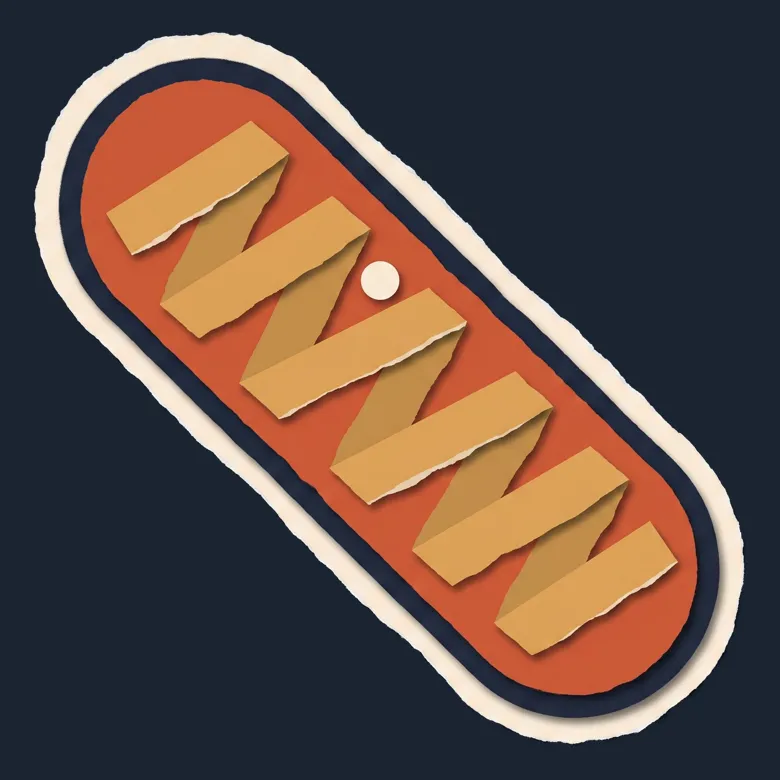
What it was
A lodger moves in and starts supplying power to the house. That is the chapter's picture of a bacterium settling inside another cell. Its descendants are mitochondria (my-toe-kon-dree-uh), the parts of your cells that help turn food into usable energy.
The host came from archaea (ar-kee-uh), another branch of single-celled life. Over time, the pair came to need each other. The smaller cell gave up much of its own set of genes, the instructions for making and running its parts. Many moved into the host's main store.
When and where
The partnership began before the oldest widely accepted complex-cell fossils, about 1.65 billion years old. It happened earlier, but no fossil shows the moment of contact. The Clock rests on the fossils we have, while the first meeting stays farther back.
How big
One of your cells can hold thousands of mitochondria. In heart muscle, they fill roughly 30 to 40% of the cell's space, about a third. That is a lot of room for the old lodgers. Other kinds of cells give them different amounts of space.
How we know
Human mitochondria still keep 37 genes in their own DNA, the molecule that stores instructions. Many more genes they need sit in the nucleus, the cell's main instruction store. Parts made outside have to come in. Gene comparisons reveal a bacterial past behind this shared work.
Still a mystery
Nobody knows whether the first partner got swallowed, invaded, or joined some other way. Scientists also debate how much the extra energy helped complex life grow. The lodger's family ties are clearer than its arrival. Its remaining genes still sit inside your cells.