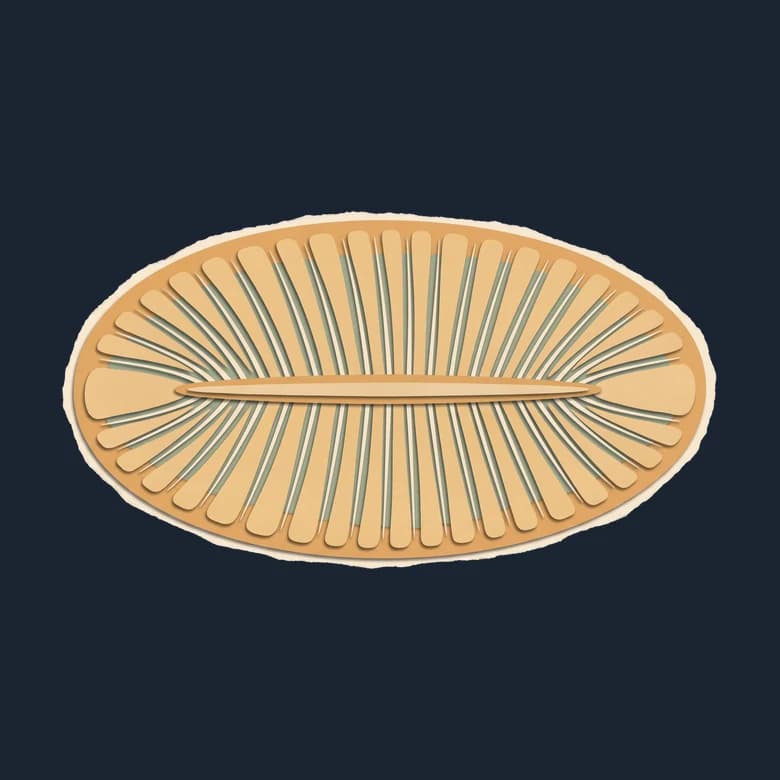
Tilt the slab under a low light and an oval rises out of the stone, ribbed like a leaf. It isn't a body. It's a print: something soft settled on mud, sand buried it, the soft parts rotted, and the sand kept the shape. No shell. No bone. Nothing hard was ever in it.
This is Dickinsonia. The smallest are a few millimeters across. The largest is over a meter; stand one on end and it comes up to your waist. Its ribs run out from a line down the middle and never quite meet. Each sits half a step off the one opposite, like the stitching on a quilt.
For seventy years, people argued about what it was. An animal? A fungus or a lichen? One giant single cell? A branch of life that tried a body plan nothing has used since? Every clue in the shape fitted more than one answer.
The answer came from a cliff on the White Sea, in northern Russia, where the rock was never cooked. On some slabs a thin dark film still lies on the print: the creature's own carbon, thinner than one page of a book.
Every living cell stiffens its skin with a molecule called a sterol. Animals use one with 27 carbon atoms (you know it as cholesterol). Fungi use 28. Plants and green algae use 29. In the film, 93 percent was the animal kind. In the rock a few millimeters away, only 11 percent. Contamination can't pick out a body like that. The answer was never in the shape. It was in the fat.
One puzzle is left. The film also held a molecule that usually forms when cholesterol passes through a gut, and nobody has ever found a gut in Dickinsonia. Was it contamination, bacteria feeding on the body, or the animal digesting the mat it lay on? That argument is still running.