
What it was
A small cell settles inside a bigger one and becomes part of its working life. Picture the lodger in Chapter 030, supplying energy from inside the house. That partnership lies deep in the history of cells like yours.
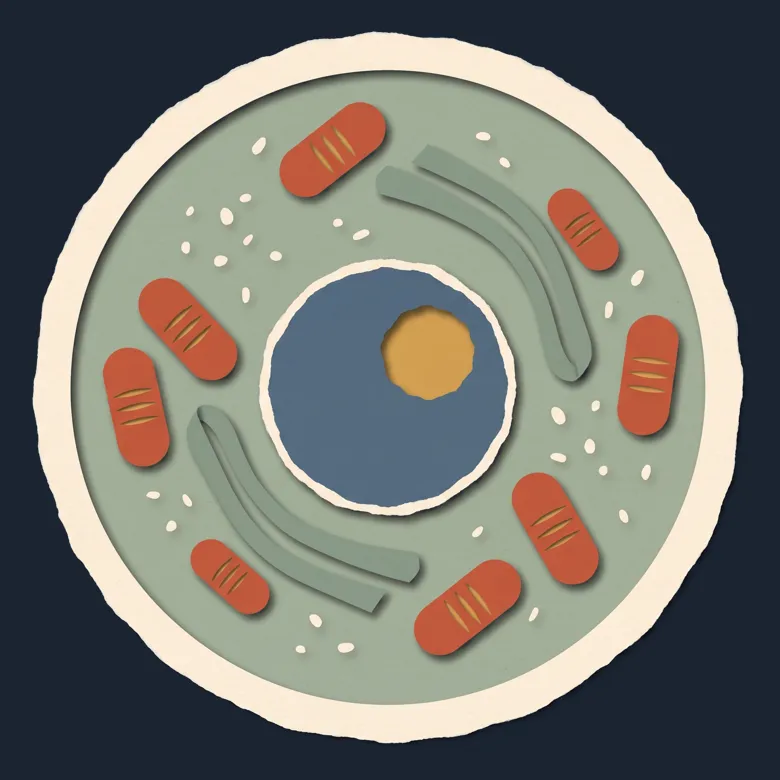
A eukaryote (you-care-ee-oat) is a cell with inner parts, including a nucleus that holds its main store of instructions. Animals and plants belong to this branch of life. The portrait stands for its early members, rather than one known cell that somebody found whole.
When and where
Widely accepted fossils of complex cells reach back about 1.65 billion years. Some come from the Ruyang Group in China. Their walls have detailed patterns that help make the case for complex cells. Being big alone would not prove it.
The changes that built those cells had already happened. The Clock marks the fossil evidence, with the merger earlier. Older claimed fossils need more checking, so the oldest accepted date is a place to stand while scientists test what lies beyond it.
How we know
Living complex cells share an ancestor that had mitochondria, energy-making parts descended from bacteria. Some later cells changed or lost those parts. They still belong to the family. Losing a part does not wipe the family links out of their genes.
Genes point to an archaeal host and a bacterial partner. Archaea (ar-kee-uh) are a different branch of single-celled life from bacteria. Fossils tell us a cell existed by a certain time; genes connect living cells whose distant ancestors left no body behind.
Still a mystery
Scientists still argue about how the partners joined and which inner changes came first. No fossil gives the complete scene. The best clues come from old cell walls and the mixed family history inside living cells.