
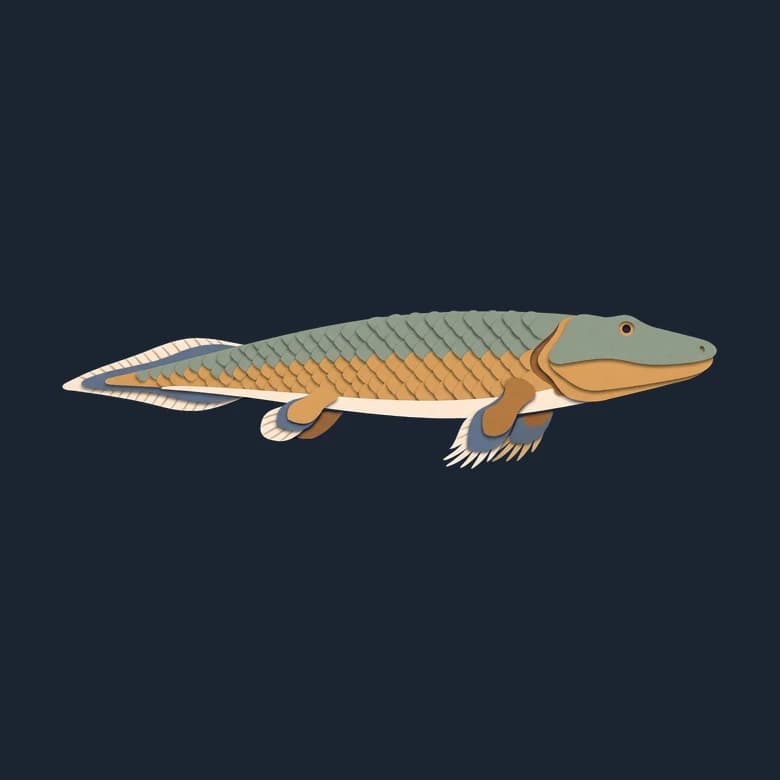
What it was
A fish about 375 million years old, with scales, fins and gills. But its head was flat like a crocodile's, with its eyes on top, and it could lift that head without moving its body. It had a neck. It could breathe air, too. Its name is a word in Inuktitut for a big freshwater fish.
The fin
One bone at the shoulder. Two bones below it. Then a cluster of small bones that could bend like a wrist. That is the plan of your own arm. Tiktaalik could plant its fins on the bottom and push its chest up off the mud.
How we found it
Scientists predicted it before anyone had seen it: its age, its rock, even its shape. It took four summers of digging on Ellesmere Island in the Canadian Arctic. In July 2004, a flat snout showed at the bottom of a quarry.
A cousin, not a grandparent
Tracks in Poland may be twenty million years older than Tiktaalik. If they are footprints, something was already walking. Tiktaalik was a late survivor that shows how the change was built.