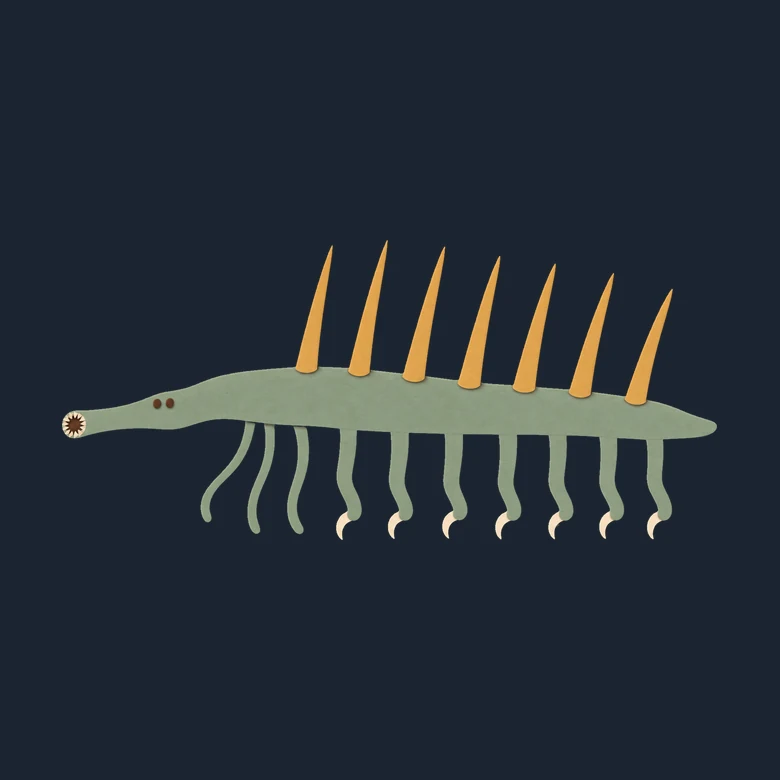
For fourteen years, science drew this animal upside down. It stood on its spines like stilts and waved a row of tentacles at the sky. When it was finally turned over, there was a second surprise. The head was on the wrong end.
Hallucigenia comes from the Burgess Shale, a band of dark rock high in the Canadian Rockies that was once the floor of a shallow sea. Mud slid over the animals living there and buried them whole, soft parts and all. The biggest Hallucigenia ever found is five and a half centimeters long, about the length of your little finger.
In 1911 the fossil hunter Charles Walcott filed it as a worm. In 1977 Simon Conway Morris looked again and saw stiff spikes on one side, soft strands on the other and a dark blob at one end. The spikes became legs. The strands became tentacles. The blob became a head. He named it for how dreamlike it looked.
In 1991 Lars Ramsköld and Hou Xianguang studied older fossils from Chengjiang in southern China, which lie on their sides with their legs in pairs. Ramsköld went back to the Burgess slabs, picked away the rock beside the tentacles and found a second row. They were legs. Turn the drawing over and the fourteen spines stand up along its back as armor.
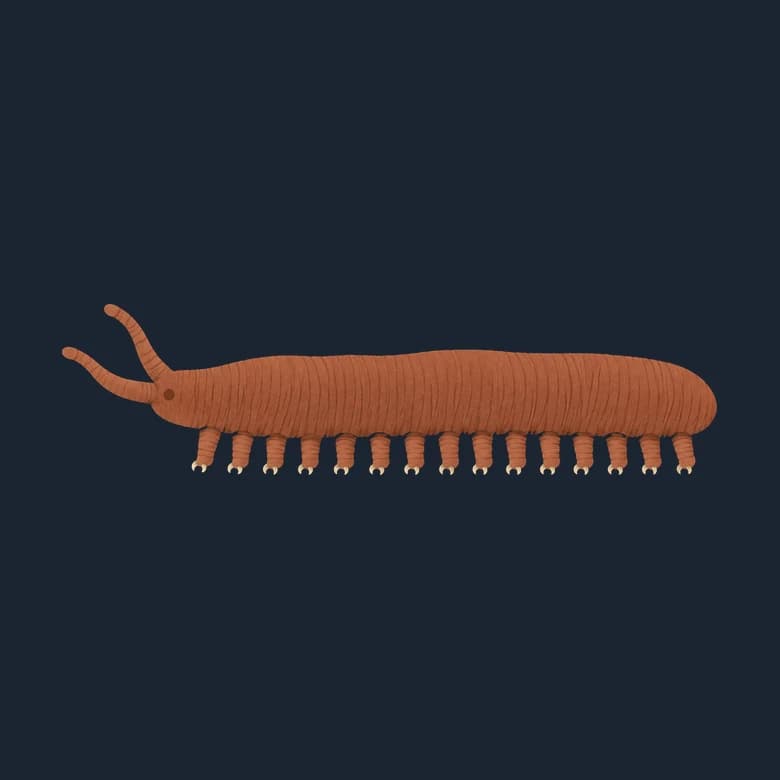
Right way up, it looks a lot like a velvet worm, a soft-legged animal that still creeps across damp forest floors today. Its claws, built as cones stacked inside cones, tie the two together. And the blob? Most likely a stain, pushed out of the body as it rotted.
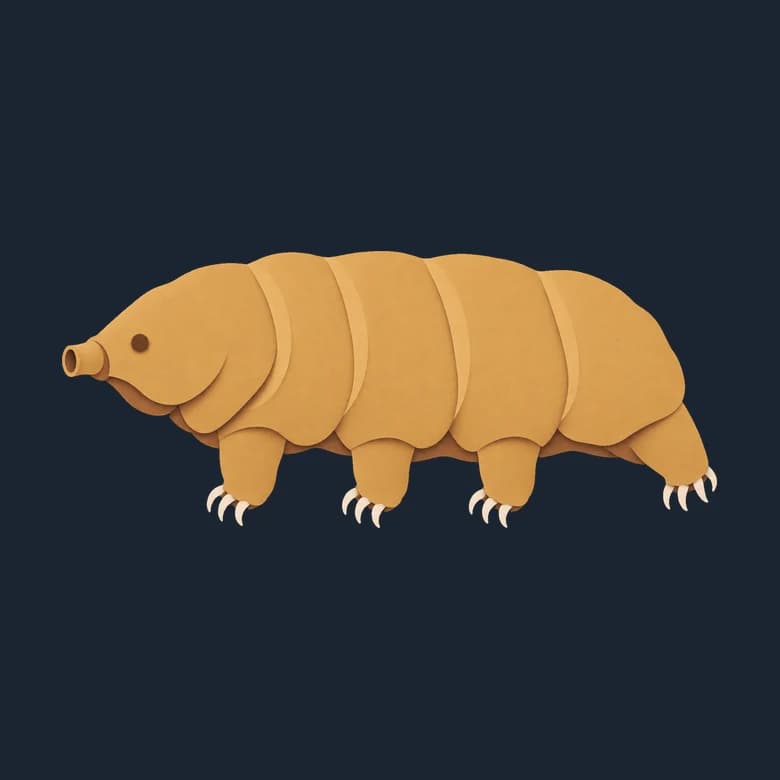
In 2015 Martin Smith and Jean-Bernard Caron found the real head at the other end: a pair of simple eyes, a mouth ringed with teeth, and a throat lined with needle-like teeth like a water bear's. It was never the animal that was strange. It was the angle we were looking from.