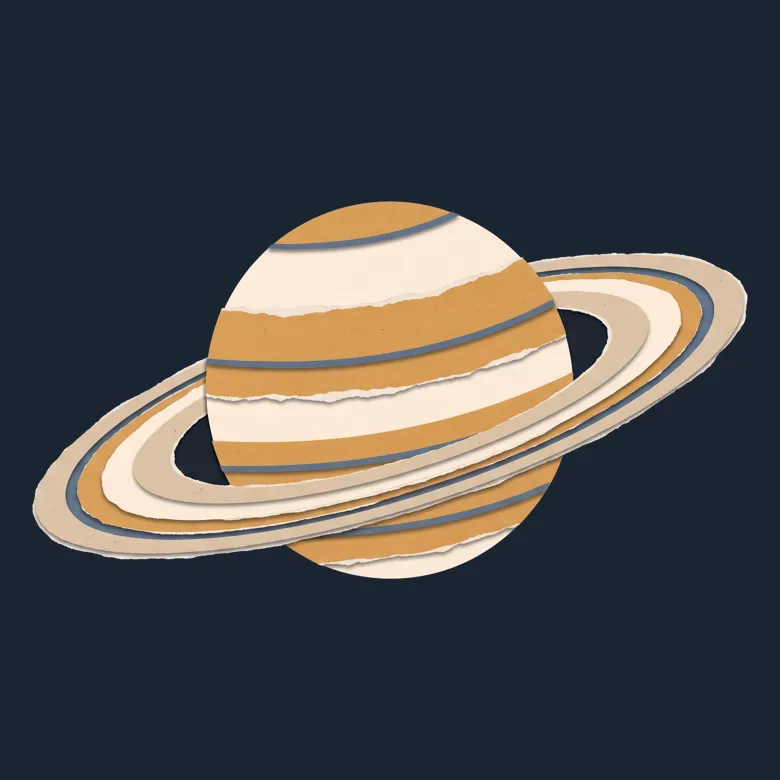
Earth once had a ring, like Saturn. Nobody has seen it. The proof is in where the rocks came down.
Go back 466 million years. Most of the land sits far to the south, and the warm, shallow seas are packed with life. Far out in the asteroid belt, a rocky world more than a hundred kilometers wide has just shattered, and its pieces are scattering through the inner solar system. One of the most common kinds of meteorite that still falls today carries the date of that breakup.
Soon after, Earth was hit far more often than usual. In one quarry in Sweden, workers have found more than a hundred fossil meteorites, sealed in limestone that was once that ancient seabed.
Then geologists counted the craters from that time. There are twenty-one. They rolled the continents back to where they sat back then and marked each crater on the map. Every single one landed near the equator. Space rock can strike anywhere, from pole to pole, and much of the land that could keep a crater lay far from the equator. The odds of all twenty-one landing in that band by chance are about one in twenty-five million. That's like flipping a coin twenty-four times and getting heads every time.
So what could aim falling rock at a planet's middle? A ring. Suppose a large asteroid passed too near Earth. Gravity pulled harder on its near side than its far side and tore it apart. The rubble spread out into a ring, and rings settle over a planet's equator, just like Saturn's. Over millions of years, the ring came down piece by piece, striking along the equator.
Here's the honest limit: this is still an idea being tested, and nobody has found the ring itself. But it explains the meteorites, the timing and the craters. Saturn still has its rings. Ours left only scars, along an equator that has long since moved.