
What it was
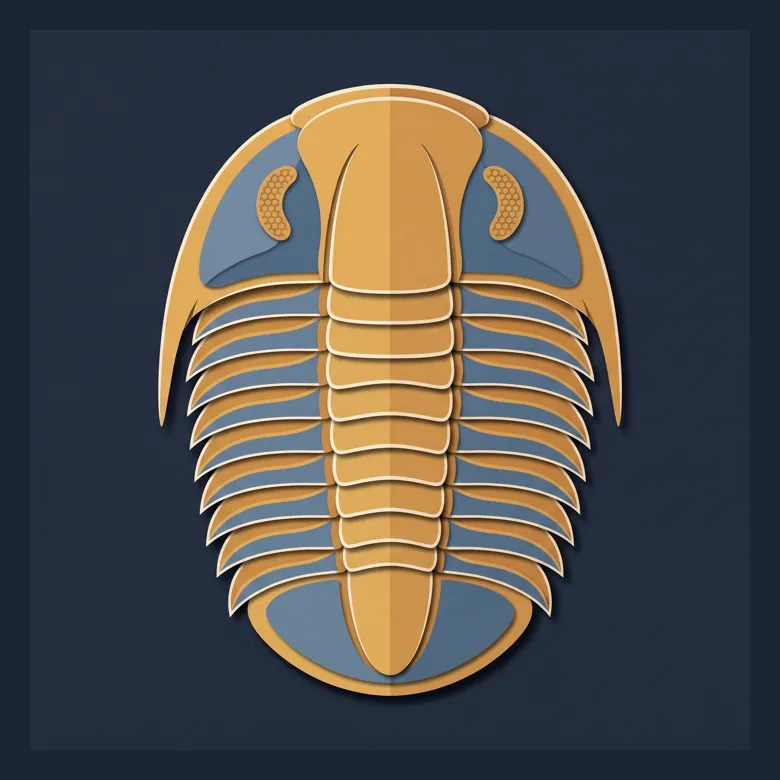
An armored animal walks over the seabed, then curls into a ball like a woodlouse. The joints in a trilobite's body let its hard covering bend. Under the armor, jointed legs carried it along.
Trilobites were arthropods, the broad group that includes insects and crabs. Some hunted; others picked up scraps. Their tough shells had a better chance of becoming fossils than the soft parts tucked beneath them. Those shells are much of what we find now.
When and where
They lived in oceans around the world. Fossils run from about 521 to 252 million years ago. The last ones vanished at the end of the Permian Period, during a mass extinction. By then, their numbers and kinds had already been shrinking for a long time.
That long fossil record lets scientists follow changes through layer after layer of rock. The last survivors show only a small part of what the group had once been. Earlier seas held many forms that disappeared before the final loss.
How big
The smallest known trilobite was shorter than the width of a strand of spaghetti. A huge specimen reached about 28 inches (72 centimeters). One fossil in your hand cannot stand for the whole range of sizes these animals grew to.
How we know
Their hard shells preserve body shapes. Trilobites shed those shells as they grew, so an empty covering can become a fossil too. Some fossils keep eyes with many lenses; others have no eyes at all. Their soft undersides are much rarer finds.
Still a mystery
Scientists still argue about how the first trilobites arose. Many forms appear early in their fossil record, with part of their past missing. Chapter 017 gives one a cameo in the final row of living things.